Beyond Chatbots: Why AI Agents Could Be the Next Major Technology Shift
For the past several years, the public conversation around artificial intelligence has centered on conversational AI. Large language models (LLMs) changed how people search for information, write text, and synthesize complex ideas. Millions of users learned to type a prompt into a text box and receive immediate, coherent answers.
However, conversational models have clear boundaries. A traditional chatbot responds to what you ask, but it waits passively for your next command. It cannot independently research a multi-step project, navigate software interfaces on your behalf, cross-reference disparate databases, or correct its own mistakes mid-stream without explicit human guidance.
This limitation marks the boundary of the current AI era—and the beginning of the next.
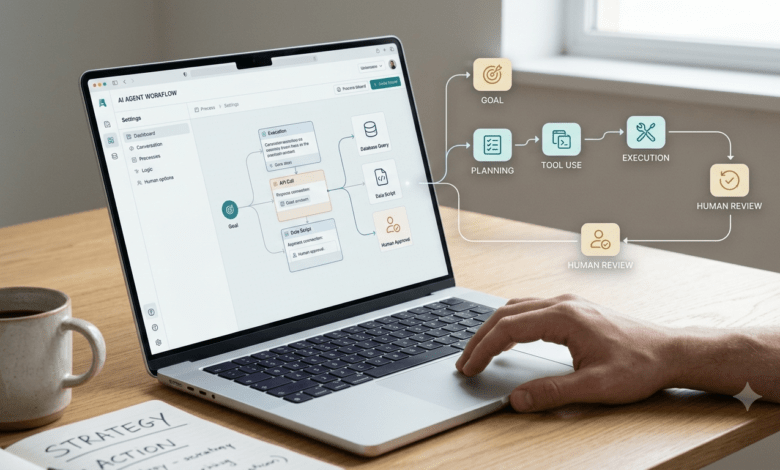
The technology landscape is shifting from conversational AI toward agentic AI. Instead of simply generating answers, AI agents are designed to reason, plan, execute multi-step workflows, interact with software tools, and adapt to changing conditions with varying degrees of autonomy.
Understanding this shift from answering questions to executing actions explains why AI agents are poised to become one of the most consequential technological evolutions of the decade.
What Are AI Agents?
An AI agent is an autonomous or semi-autonomous software system driven by underlying AI models that perceives its environment, formulates plans, makes decisions, and executes actions to achieve specific goals.
While a basic language model predicts the next statistically likely word in a sentence, an AI agent operates within an environment. It processes an objective, breaks that objective down into discrete sub-tasks, selects appropriate tools to accomplish those tasks, evaluates its own progress, and iterates until the goal is completed or human intervention is required.
Core Characteristics of AI Agents
-
Goal-Oriented Planning: Agents do not merely respond to static inputs; they accept high-level objectives (e.g., “Schedule a business trip within budget”) and determine the sequence of steps needed to achieve them.
-
Tool Integration: Agents use external tools such as web browsers, API integrations, software interfaces, code execution environments, and databases to perform actions beyond basic text output.
-
Memory Management: Agents maintain both short-term memory (context across a current workflow) and long-term memory (historical preferences, organizational policies, and past outcomes) to inform future decisions.
-
Environmental Reflection: Capable agents evaluate the results of their own actions. If an API call fails or an initial search yields incomplete data, the agent can adjust its strategy autonomously.
-
Autonomous Execution: Agents act with varying levels of human oversight, operating independently within predefined permission boundaries.
AI Agents vs. Traditional Chatbots
To understand the practical difference, consider how traditional chatbots, AI assistants, and autonomous AI agents handle the same business request: “Organize a competitive research report on top market alternatives.”
| Feature / Capability | Traditional Chatbot | Advanced AI Assistant | Autonomous AI Agent |
| Primary Function | Answers questions based on training data or single queries. | Retrieves real-time data and drafts content with human guidance. | Orchestrates end-to-end multi-step workflows across systems. |
| User Interaction | Single prompt-and-response turn. | Multi-turn conversational dialog. | Goal-oriented objective with periodic checkpoints. |
| Planning Capabilities | None; responds immediately to the input text. | Basic linear task execution. | Dynamic task decomposition, sub-task prioritization, and self-correction. |
| Tool Usage | Rare or limited to basic web search integrations. | Standardized search plugins and predefined connectors. | Autonomous selection and execution of software tools, APIs, and code. |
| Error Handling | Hallucinates or stops if data is missing; relies on user correction. | Asks the user to clarify or rephrase input. | Retries failed steps, selects alternate sources, and validates outputs against goals. |
| Human Role | Drives every single step of the interaction manually. | Guides the process through step-by-step prompts. | Approves high-stakes actions and defines governance guardrails. |
A traditional chatbot acts like an instant digital encyclopedia. An AI assistant acts like a smart co-writer. An AI agent acts like a project coordinator capable of using software tools independently.
Why AI Agents Are Becoming More Important
The migration toward agentic AI is driven by several converging technical developments across software engineering, machine learning, and enterprise infrastructure.
       [ Foundation Models ]
     (Reasoning & Context Windows)
                 +
  [ Tool Integration Infrastructure ]  ===>  [ Practical AI Agents ]
      (APIs, Function Calling)
                 +
 [ Frameworks & Agentic Memory ]
1. Advanced Reasoning Capabilities
Earlier generations of language models struggled with multi-step logic. Recent structural improvements in reasoning models allow AI systems to pause, verify intermediate logic, trace step-by-step chains of thought, and catch procedural errors before acting.
2. Expanded Context Windows and Memory
Modern models process hundreds of thousands—or millions—of tokens in a single context window. This expansion allows an agent to hold entire software documentation sets, codebase repositories, corporate policies, and ongoing project histories in active memory simultaneously.
3. Native Function Calling and API Integration
AI model developers have integrated native function calling into foundation models. Rather than guessing text outcomes, models can emit structured data (such as JSON) designed to trigger external software tools, invoke REST APIs, query SQL databases, or execute computer code natively.
4. Developer Frameworks and Orchestration
Open-source and enterprise frameworks—including Orchestration tools like LangChain, AutoGen, CrewAI, and native cloud agent development kits—have simplified how developers build, connect, and deploy multi-agent systems.
How AI Agents Could Transform Businesses
The business value of conversational AI centered on speed of content creation and quick information retrieval. The economic impact of AI agents, however, rests on workflow automation and operational scalability.
Traditional enterprise software relies on deterministic automation: “If X happens in Application A, copy Y data to Application B.” While efficient for fixed processes, deterministic automation breaks down whenever unstructured data, ambiguous decisions, or novel edge cases arise.
AI agents introduce probabilistic intelligence into automated workflows:
Deterministic Automation:  [Fixed Trigger] ----> [Fixed Rule] ------------> [Predefined Action]
Agentic Automation:        [Dynamic Goal] ----> [Reasoning & Tool Selection] -> [Adaptive Execution]
By combining logical flexibility with software access, AI agents can handle tasks that previously required human cognitive evaluation, such as interpreting vendor emails, resolving mismatched invoicing records, or writing customized data scripts.
Real-World Use Cases for AI Agents
To see how agentic architecture operates in practice, consider these practical applications across key functions:
1. Software Development and Maintenance
Rather than merely autocomplete lines of code, software engineering agents can be assigned issue tickets from repositories like GitHub.
-
The Workflow: The agent reads the bug report, locates the relevant files in the codebase, writes a unit test to reproduce the bug, modifies the source code to fix the issue, verifies that all tests pass, and submits a pull request for human review.
2. Business Operations and Financial Reconciliation
In complex accounting environments, invoices frequently fail automated matching due to formatting mismatches or missing line items.
-
The Workflow: An operations agent detects an unmatched invoice, queries external logistics APIs to verify shipment tracking numbers, cross-references internal purchase orders, drafts a missing line item adjustment, and routes the completed file to a finance manager for final sign-off.
3. Comprehensive Research and Market Analysis
While a traditional query yields a static list of search results, a research agent conducts thorough investigations.
-
The Workflow: Given the objective to analyze a competitor’s pricing structure, the agent scrapes public regulatory filings, extracts pricing tiers from corporate websites, synthesizes recent earnings call transcripts, structures the findings into a relational schema, and generates a formatted briefing paper complete with source citations.
4. Healthcare Administration and Prior Authorization
Prior authorization processes require cross-referencing patient charts, insurance guidelines, and diagnostic coding systems.
-
The Workflow: An administrative healthcare agent reviews clinical documentation against insurance policy criteria, flags missing lab reports, alerts medical staff to specific missing data, and prepares standardized submission packages for insurance claims.
5. Cybersecurity and Threat Triage
Security Operations Centers (SOCs) face overwhelming alert volume daily.
-
The Workflow: A security agent ingests real-time network logs, flags anomalous traffic behaviors, automatically queries threat-intelligence databases to check IP reputations, isolates compromised virtual environments, and presents a structured timeline of events to human incident responders.
The Core Architecture: How an AI Agent Works
To understand why agents can handle complex workflows, it helps to examine their internal logical loop.
       +---------------------------------------------+
       |             1. Receive Objective            |
       +---------------------------------------------+
                              |
                              v
       +---------------------------------------------+
       |         2. Task Planning & Reasoning        |
       +---------------------------------------------+
                              |
                              v
       +---------------------------------------------+
       |   3. Tool Selection & Execution (APIs/Code) |
       +---------------------------------------------+
                              |
                              v
       +---------------------------------------------+
       |    4. Environmental Evaluation & Memory     |
       +---------------------------------------------+
                              |
              +---------------+---------------+
              |                               |
     [Goal Achieved?]                 [Goal Unmet?]
              |                               |
              v                               v
   +--------------------+          +--------------------+
   |  Deliver Output /  |          | Adjust Strategy /  |
   | Request Approval   |          | Retry Sub-Task     |
   +--------------------+          +--------------------+
-
Perception and Input Processing: The agent receives a high-level goal along with system constraints, environmental access rights, and memory context.
-
Decomposition and Planning: The underlying reasoning engine breaks the complex goal into an ordered series of smaller, manageable actions.
-
Action and Execution: The agent interacts with external systems using specialized tools (e.g., executing Python scripts, querying a database, sending an API call).
-
Observation and Self-Reflection: The agent reads the output of its action. If the step succeeded, it advances to the next task. If an error occurred, it analyzes the failure and attempts an alternative approach.
-
Human-in-the-Loop Checkpoints: For sensitive actions (such as initiating financial transfers or deleting records), the agent pauses execution to request authorization from a human supervisor.
The Benefits of Agentic AI
Organizations adopting agentic architectures move past isolated productivity boosts toward comprehensive process optimization:
-
Shift from Prompting to Delegating: Instead of micro-managing AI models with repeated prompt engineering, teams delegate outcomes, freeing human workers for strategic, creative, and interpersonal challenges.
-
Dynamic Adaptation: Unlike rigid script-based software, AI agents handle missing variables, variations in input formatting, and unexpected workflow steps without crashing.
-
Continuous Operations: Agents perform routine data validation, research monitoring, and administrative background tasks around the clock.
-
Enhanced System Interoperability: Agents bridge the gap between legacy enterprise systems that lack native integrations by interacting dynamically through APIs or user interfaces.
The Risks and Challenges
Despite their promise, autonomous agents introduce structural and technical challenges that require careful management.
1. Reliability and Hallucinations
While reasoning capabilities have advanced, language models can still make logical errors or hallucinate facts. When a standard chatbot hallucinates, it displays incorrect text. When an autonomous agent hallucinates mid-workflow, it might execute an incorrect database query, send an improper notification, or delete critical data.
2. Cascading Errors in Multi-Step Workflows
In complex agentic sequences, an error made during step two compounds across subsequent steps. Without continuous verification routines, an early mistake can derail the entire process.
3. Security and Permission Management
Granting AI software the ability to read emails, execute code, and write to enterprise databases introduces new attack vectors:
-
Indirect Prompt Injection: A malicious file or web page read by an agent could contain hidden instructions designed to hijack the agent’s permission levels.
-
Privilege Escalation: Organizations must apply strict principle-of-least-privilege governance, ensuring agents only hold permissions necessary for specific tasks.
4. High Computational and Financial Costs
Agents often execute dozens of model calls, database queries, and tool interactions to complete a single objective. Running autonomous agent fleets at scale can generate significant compute costs compared to simple conversational queries.
5. Regulatory and Accountability Gaps
If an autonomous agent executes a compliance violation or commits an administrative error, establishing legal and operational liability remains a complex challenge. Businesses must define clear human oversight protocols for all high-stakes agent workflows.
Will AI Agents Replace Human Workers?
A persistent concern regarding autonomous software is workforce displacement. However, the history of enterprise technology shows that automation primarily shifts the nature of work rather than eliminating human involvement.
Traditional Workflow: [Manual Data Entry] --> [Manual Analysis] --> [Manual Execution]
Agentic Workflow:     [AI Data Gathering] -> [AI Analysis Drafting] -> [Human Strategy & Sign-Off]
AI agents excel at structured execution, data aggregation, and administrative throughput. However, they lack essential human qualities:
-
True contextual business judgment and ethical reasoning
-
Deep domain intuition built on real-world experiences
-
Relationship building, emotional intelligence, and stakeholder negotiations
-
Creative vision and high-level strategic directional setting
Consequently, the immediate effect of agentic AI is not the wholesale replacement of employees, but the emergence of the Agent-Assisted Worker. In this paradigm, professionals operate as supervisors and managers of software agent fleets—setting objectives, establishing policy guardrails, validating work quality, and handling non-standard exceptions.
What the Future of AI Agents Could Look Like
As agent development matures over the coming years, several structural trends will likely shape enterprise computing:
                          [ Current State ]
               Single-agent systems with explicit tools
                                  │
                                  ▼
                         [ Near-Term Shift ]
          Multi-agent collaboration & standardized communication
                                  │
                                  ▼
                         [ Long-Term Vision ]
Autonomous operational networks operating within human-defined guardrails
-
Multi-Agent Collaboration Networks: Complex problems will be handled by specialized teams of agents. For instance, a software development workflow may pair a project manager agent with a coding agent, a security review agent, and a testing agent—all communicating through standardized protocols.
-
Standardized Agent Interoperability Protocols: Much like HTTP enabled web communication, emerging protocols will standardize how software agents securely authenticate, exchange data, and hand off tasks across corporate networks.
-
Custom Enterprise Knowledge Repositories: Organizations will structure internal knowledge specifically for agent consumption, combining secure vector stores, structured schema graphs, and strict operational guidelines.
-
Hardware-Accelerated On-Device Agents: As lightweight local models improve, consumer hardware (laptops, smartphones, and edge devices) will run private agents locally, managing schedules and workflows without relying exclusively on cloud servers.
Conclusion
The evolution of artificial intelligence from static knowledge retrieval to dynamic task execution represents a fundamental shift in software design. Traditional chatbots demonstrated that AI can understand human language; AI agents demonstrate that AI can interact meaningfully with computer systems to accomplish real work.
By combining logical reasoning, memory management, tool usage, and adaptive planning, agentic systems bridge the gap between static content creation and practical automation.
For business leaders, developers, and knowledge workers, the objective is not to wait for perfect autonomy, but to understand how agentic workflows operate today. Organizations that master human-in-the-loop oversight, secure permission structures, and clear agent delegation will lead the next decade of digital productivity.